ZUBEEN GARG: A TRIBUTE
'The need of the hour is to contextualize Zubeen Garg’s sublime ideology as a people’s artist,' writes Sabreen Ahmed
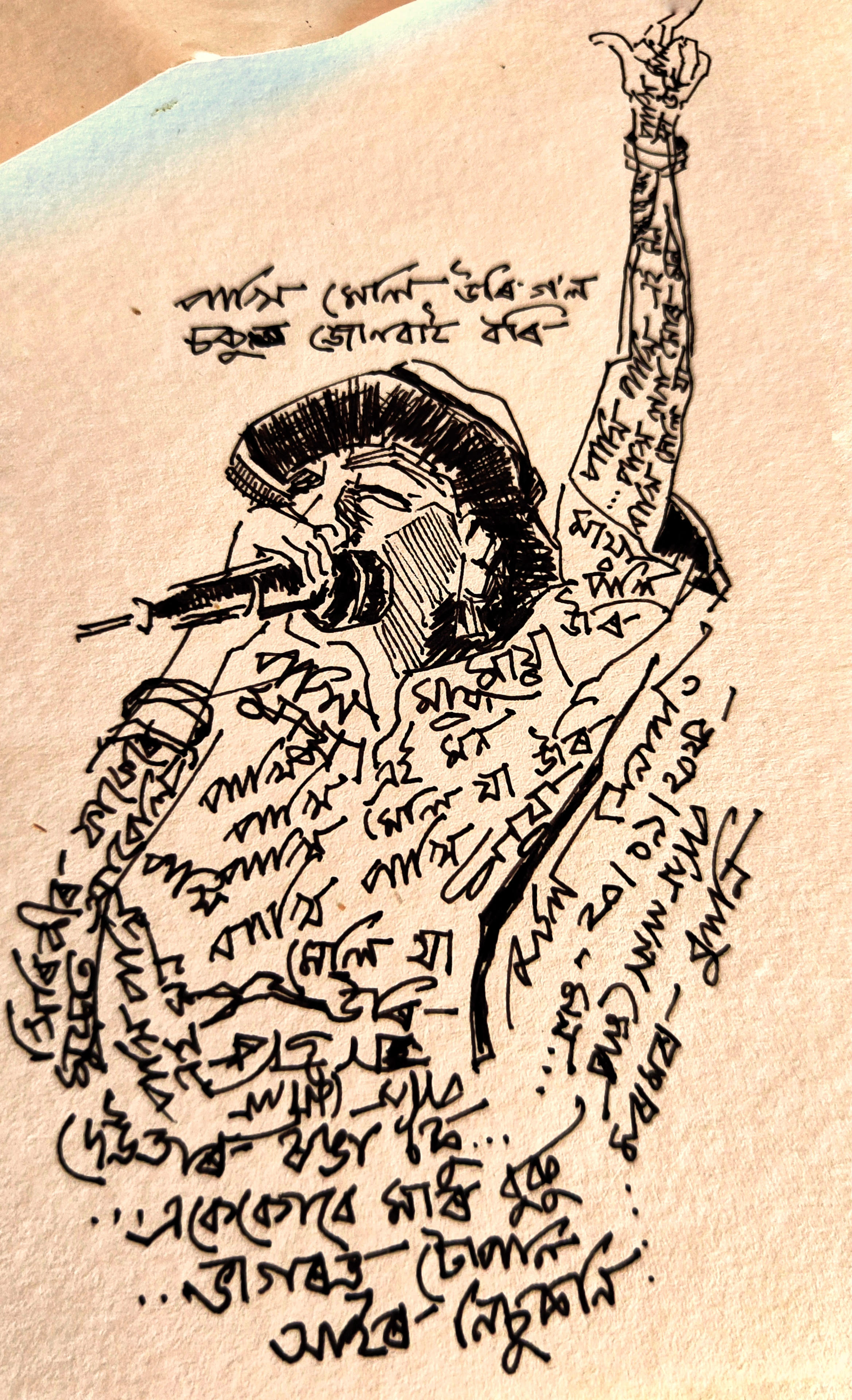
The untimely and sudden loss of a cult figure Zubeen Garg has led to mass tragedy for millions of people and the subsequent public outcry for justice has taken the shape of a Populist movement in Assam. Who is a cult figure? According to American psychiatrist Deikman, “A cult is most commonly thought of as a religious or utopian group with a charismatic leader, though not all cult leaders are charismatic”. Zubeen Garg as a cult is an exception. Culture is the way of conforming to a dominant social norm while cult is an alternative way of finding freedom from dominance, sometimes in a non conformist way. This is precisely why Zubeen Garg is also a cult who found his creed through his songs that spoke large volumes about social justice in an apolitical jargon. Pantheism and environmental justice were his key concerns which could have been organised in the pattern of the celebrated environmentalist Greta Thunberg.
A term “Zubeenism” has been recently floated in social media after the legendary singer’s death as an alternate reflection of his cult image that made him more than a cultural icon. However Zubeen in his lifetime shed away from all religious ties or attempts of indoctrination and had declared himself an atheist, so the idea of divine revelation in association with Zubeen has no coherence with his life goals. It is said that cult behaviour always employs emotional arousal to prevent objective thinking and put people into trance states where they are more open to delusion. But the response of millions of people to unearthing the truth behind Zubeen’s death and the trauma over his loss is not simply an example of mass hysteria or cult behavior often denigrated by conformist society. The meta-communication of Zubeen’s metaphors like a ‘lost rainbow’, ‘burnt ashes’, ‘the unfulfilled promises of liberty and peace’ natural motifs of ‘the moon’ as longing and ‘the sun’ as positive beginning and his ‘pantheist ideal of nature as God’ has united the Assamese community in a miasma of unresolved grief not just for a rockstar, but for a messianic voice that enlightened common people against blind conformism by transcending private contemplation to unforeseen public tragedy.
The chanting of his musical fantasy Mayabini as an anthem of mourning and plea for justice across the state exhibits the binding force of his elusive cult, unknown to many during his lifetime. India is not Israel where mountain Zion is situated as per biblical information, while Zubeen called himself Kanchenjunga who defied all caste, creed and religion and stood tall with his non-conformism. The suspicious circumstances of his death is a part of systemic cultural violence of silencing a powerful anti establishment voice. The ethno-culturalism in Zubeen’s songs may not be similar with the self-determination of Zionism that urged Jews to assimilate in Western secular culture; but they are an example of unadulterated self determined love for the land, people and its language.
Zubeen has urged none to embrace the political meta-narrative of Assamese ethno nationalism or Axomiya Jatiyotabad. Yet his songs breathe the purity of agrarian life and the civil society of contemporary Assam emerging from the fearful extremism of the early nineties to the turn of the century that spontaneously assimilated the entire rubric of Assam in the secular creed of his music. The power of Zubeen as a cult of drawing people in his lifetime was used for global merchandise. Nonetheless he called himself a social leftist and has several examples of social activism that indeed made him a messiah for the downtrodden. This is revealed by the circumstances around his death and its mystery for which proper justice is being demanded from all corners of Assam which itself is a counter populist movement against a capitalist domain. “In the academic debate, largely based on methodological individualism, power is mostly conceived as an interpersonal relation, and counter-powers have no specific role, unless as opposing powers” (Palermo 2024).
In the last few decades, we have seen a rise of social movements, progressive movements like anti-globalization movements; Arab Spring, Southern Europe and Occupy Wall Street all seemed to spearhead a global move toward more socialistic societies, especially the PinkTide of SouthAmerica. So too did cultural movements like Me-Too or Black Lives Matter impact consciousness and values but with only incremental immediate influence (Langman 2022). Will the current mass reaction in Assam after the death of the most popular voice of the z generation reach similar magnitude? Will they too be short lived as the ones cited above? The mass hysteria following the death of the Zubeen Garg and the silent marches demanding justice are no less than a revolution in Assam making his funeral the fourth largest funeral procession in the world. The state still waits for justice. The state has orchestrated the demands of the people in setting up action plans, including the arrests of prime suspects. The nexus of politics and multinational capitalist connections cannot be ruled out. The capitalist dispossession of labour from the means of production gives rise to a complex number of class forms unique to capitalism, the role of Zubeen Garg’s management of financial assets and the issue of his copyright of songs is crucial in this regard, as it has overt connection to capitalist usurpation of public resources of a legendry singer.
The countermovement with Zubeen’s death in Gramscian terminology saw an unprecedented hegemonic union, though momentary, of the civil society of the Assamese masses and the political society led by the government in the new class–caste unity of the organic intellectualism of Zubeenism. The investment of grief in this countermovement reigned for the cudgel of power over the death and subsequent delayed justice for a cult and an icon Zubeen Garg that exposed the unchartered overseas activities of the organizers of North East Festival, few Assamese individuals at Singapore and the artist’s financial manager and associates. Adani’s courtesy visit to the singer’s family in the meanwhile too is pondered by many as a commercial motive. The mystery is yet to be resolved.
The need of the hour is to contextualize Zubeen Garg’s sublime ideology as a people’s artist. Can Zubeen’s Mayabini be what Zizek proposed as “The Sublime Object of Ideology”? Zubeenism can be a true counter-movement, from Slavok Žižek's perspective, if it can go beyond compromise and immediate patronizing reforms like building statues in favor of a radical call for a complete revolutionary overthrow of the existing system of commercialization by building more resources for knowledge generation like digital archives and physical libraries in every nook and corner of Assam. The words of the legend himself: “A community without books cannot be saved by its Gamusa” has a messianic impulse to universal emancipation, the fuel for success of a countermovement which involves a decisive and uncompromising stance against systemic violence --- be it exploitation of human or the environment.
The Zizekian concept of the “terminal crisis” of capitalism is visible in the apocalyptic turn of environmental change through cutting of trees and diminishing of forest and farm resources in Assam against which Zubeen Garg raised a potential voice. The justice for Zubeen’s death shall be incomplete if there is no justice for the swallowing of his natural kingdom of golden Assam under globalised exploitation, be it natural oil, the tea gardens, the one horned rhino or the copyright of the legends’ songs. Zubeenism can only thrive if it can sustain itself as a people’s movement for all forms of resistance towards injustice to nature and human kind. Zubeen Garg’s legacy has to live on with power as the apolitical populist king in all future struggles for justice as Zubeenism. We are Zubeen.
Sabreen Ahmed is Associate Professor, Department of English at Nagaon University, Assam



.jpg)















 (1).jpg)