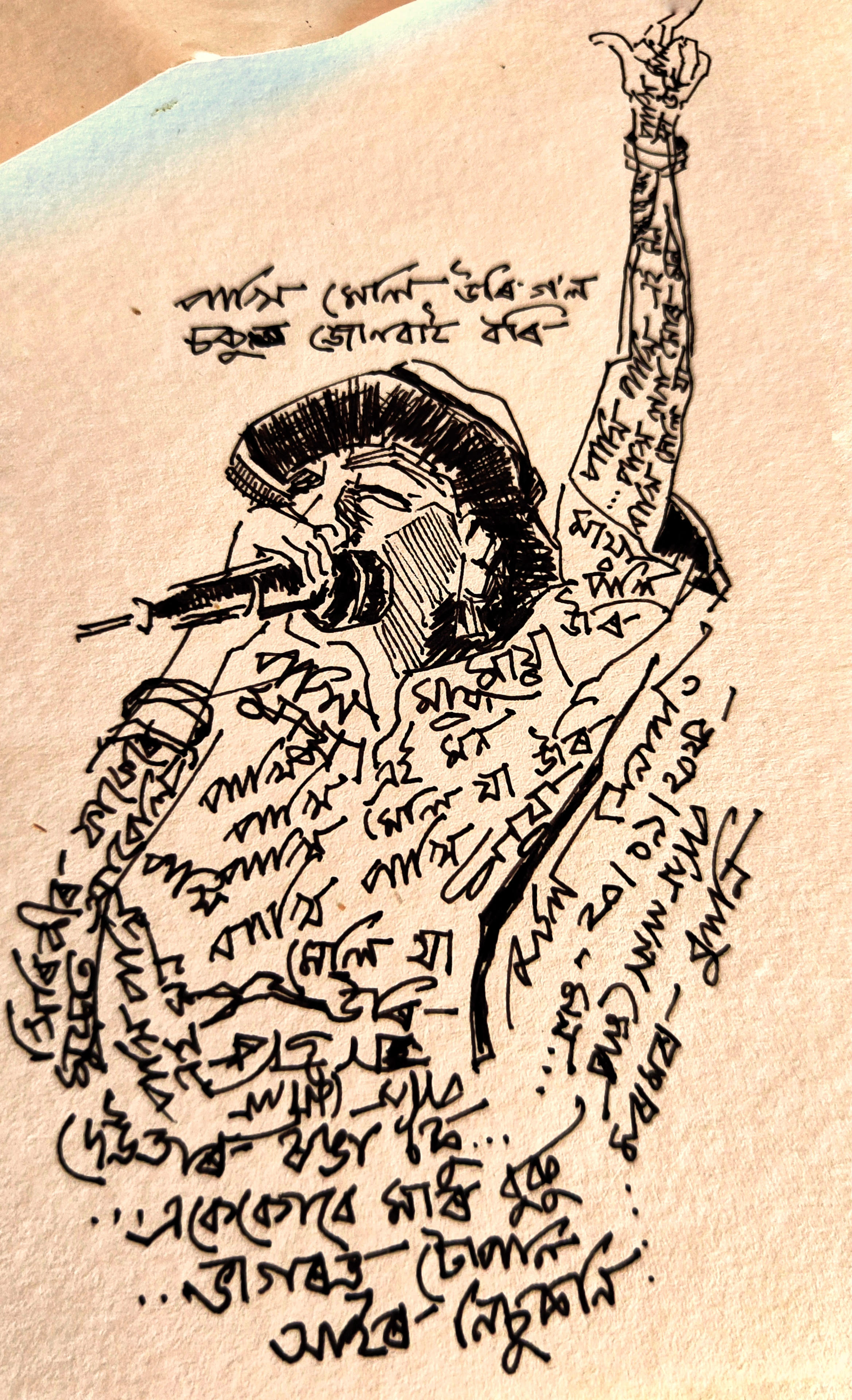
ZUBEEN GARG: A TRIBUTE
Zubeen Garg’s passing leaves Assam in collective grief, writes AMITABH RANJAN KANU
Deeply saddened by the passing of Assam’s heart-throb, Zubeen Garg, whose voice was the eternal pulse of the people - now suddenly silenced. His death has brought forth a wave of collective grief, even though grief is often a private emotion. People who never met him in person still feel the loss as their own, because his voice was woven into the very fabric of Assamese social life -- transcending class, language, and community. Restless like a Renaissance man, Zubeen refused to be confined to a single identity. He celebrated multilingualism with passion. Famously, he walked off the Bihu stage at Noonmati, Guwahati, when the organizers restricted him from singing Hindi songs -- an act that reflected his uncompromising stance on artistic freedom. Outspoken, sometimes controversial, but always honest, Zubeen spoke as he felt, sang as he believed, and lived life on his own terms. He was the voice of the voiceless, approachable to all, which drew people closer to him. Over time, he and his music became inseparable -- his songs and his persona fused into one. That is why his passing has left Assam in a state of profound collective mourning. Zubeen Garg was a revolutionary soul and an emotional anchor for our generation. His music became a symbol of identity, resilience, and belonging. Deeply rooted in the cultural, political, and social fabric of Assamese society, his songs compelled listeners to reflect on questions of identity reconstruction and reclamation.
Zubeen Garg ‘s music has served as a symbol of identity, resilience, and belonging for many. Deeply rooted in the cultural, political, and social issues of Assamese society, his songs encourage reflection on the reconstruction and reclamation of identity. Some of his compositions subtly highlight the exploitation of Assam’s natural resources. He has also raised his voice against the devastating floods that plague the state every year. Zubeen gave soul-wrenching voice to the lyrics of Diganta Bharati. Much like Bob Dylan’s Chimes of Freedom, one of Zubeen's songs becomes a melodious expression of the unspoken feelings of millions. This song speaks directly to Assam’s natural calamities while drawing vivid imagery to portray social injustice and the struggles of the downtrodden. Another notable song, Zantra, delves into the concept of routine or daily life. This can be analyzed through various theoretical lenses. The repetitive routines followed by children and adults alike contribute to the reproduction of social structures and norms. In this context, repetition reinforces social expectations and maintains social order. This perspective aligns with Michel Foucault’s work on discipline and power, which suggests that daily routines can act as mechanisms of control, subjecting individuals to schedules and repetitive tasks that regulate their behavior. Simultaneously, the song can also be interpreted through Karl Marx’s concept of alienation, which argues that mechanized and repetitive labor can lead to a sense of disconnection and dehumanization. Here, the monotony of daily tasks reflects a form of alienation -- where individuals feel as if they are simply going through the motions, devoid of purpose or fulfillment.
There is always a certain melancholy in Zubeen’s music -- it feels as if something within it is pulling you back, tugging at hidden corners of your heart, enveloping you in a darkness where life breathes and echoes. His most painful songs bring to mind the line, “Our sweetest songs are those that tell of saddest thought,” written by the Romantic poet P.B. Shelley, who himself died by drowning. Although Shelley’s death was ruled accidental -- he was sailing with his friends Edward Elleker Williams and Charles Vivian in the Gulf of Spezia off the coast of Italy when their boat was caught in a sudden storm -- there was no suggestion of foul play. But in the case of Zubeen Garg, questions emerged when he nearly drowned, despite prior medical advice warning him to avoid water and fire due to his history of seizures. Reportedly, his manager, Siddharth Sarma, had significant influence and control over Zubeen, as was often visible during public performances. Allegations later surfaced about Sarma's involvement in fraudulent business practices, drawing parallels with Elvis Presley’s infamous manager, Colonel Tom Parker, who negotiated a 50/50 partnership with Presley -- a deal that ultimately allowed Parker to earn more than the artist himself. In contrast, Zubeen Garg -- our humble son of the soil—stood as a companion to ordinary people. He wasn’t just a voice of the masses; he became a first responder during floods, organized relief camps, sang to raise donations, and even opened his own home to COVID-19 patients. He played charity football matches, collected clothes and medicines, and, through these actions, reminded us that fame need not create distance—it can also build intimacy. It can bring one closer to people, especially when they need you the most.
Profoundly human Zubeen Garg visited my hometown, Gauripur, and spent a night at the Matiabagh Palace, choosing it over the Circuit House of Dhubri during his last visit. He loved the palace for its serenity, far from the humdrum and crowd of the city. His song Mayabini is a heart-touching melody about love and longing. In a stage performance, he once jokingly told his audience that when he died, people would sing that song. And indeed, the love people had for him was evident -- during his final journey, people sang Mayabini like an anthem, even as his pyre was burning. It was a phenomenon to witness -- how deeply a singer could be loved and admired by his people. It makes one reflect: what made Zubeen Garg so special that thousands came out to pay their respects, creating a gathering that echoed the public outpouring after the death of Michael Jackson? Jackson too died at the age of 50 due to medical negligence when his personal physician, Dr. Conrad Murray, administered propofol to help him sleep without proper medical supervision or equipment. Murray later served two years in prison. Likewise, Zubeen Garg tragically passed away in Singapore due to personal and medical negligence. Zubeen had no interest in elite society, and that gave him the courage to speak out fearlessly on public issues. He became a revolutionary artist with an imaginative and daring mind. After Jitul Sonowal, it was Zubeen’s voice that resonated with generations. His music became a refuge -- a place where anyone could rest, sing, and find solace, whether in solitude or celebration. His passing plunged the region into immense grief. Zubeen da’s death and the profound public mourning it evoked must be understood in a larger context, where private sentiment transforms into collective remembrance. This was possible because of his lifelong rejection of caste, religion, language barriers, and social hierarchies. Thousands of fans gathered to bid him farewell, showcasing the deep love and admiration he commanded in his lifetime. His memory must not be overshadowed by narrow chauvinism, for Zubeen Garg stood for inclusivity and understood the richness of diverse cultural perspectives. That is what made his death not just a personal loss, but a moment of shared, national mourning and remembrance.
Amitabh Ranjan Kanu teaches in Pramathesh Barua College, Gauripur, Dist. Dhubri Assam. He is a poet and translator. He can be reached at kanupbc@rediffamil.com




.jpg)


















 (1).jpg)