
SATTYAKEE D'COM BHUYAN recalls how Bhupen Hazarika had a piping hot meal waiting for him in every home in Assam
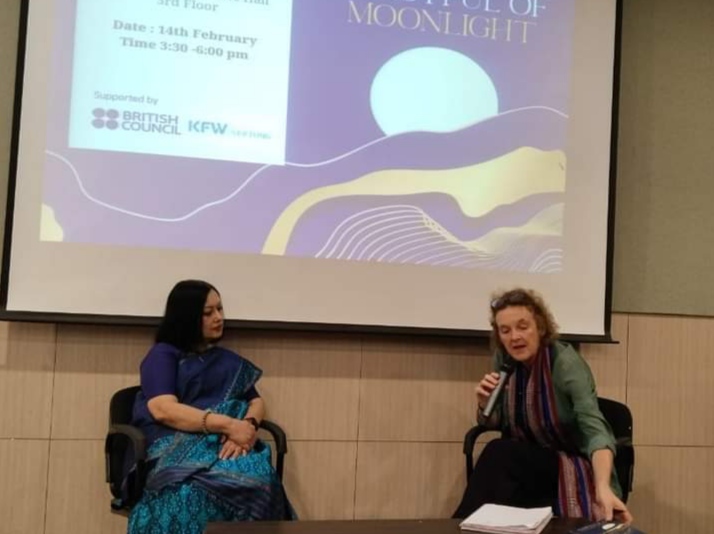
(Pix: A Book by Anuradha Sharma Pujaree released on the occasion of the birth centenary celebrations of Bhupen Hazarika)
As Assam readies itself for the grand centenary celebrations of Bharat Ratna Dr. Bhupen Hazarika, the Bard of the Brahmaputra whose voice still echoes in every household, there is a quiet reminder that behind the legend stood a man of startling honesty. On his birthday, while the state prepares with music festivals, screenings, and tributes, it is worth remembering Hazarika’s own haunting confession: “I was a failure as a son, as a lover, and as a brother. My only success was that every house in Assam decorated me, and wherever I went, there was food available for me.”
These words, stark yet tender, reveal the paradox of his life: a man who carried the applause of the world, yet admitted to personal absences at home.
Born in Sadiya in 1926, Hazarika’s journey took him from the banks of the Brahmaputra to the world stage. He sang for Jyotiprasad Agarwala as a child prodigy, studied at Banaras Hindu University, and later walked the halls of Columbia University in New York, where he befriended global voices of struggle and solidarity. His music became an anthem for empathy and justice, his cinema gave voice to Assamese culture, and his activism connected Assam to international movements.
And yet, in quieter moments, he admitted to the pain of being absent from his own family. His relentless pursuit of causes larger than himself meant missed birthdays, forgotten rituals, and relationships that frayed.
An anecdote often recalled by close friends speaks of how Hazarika would arrive home after long absences with bags full of books and recordings, eager to share what he had seen abroad. But while he spoke with great passion about the world, his siblings and relatives quietly longed for the simple intimacy of his presence at dinner. It was as though the Bard could never belong to just one household.
Renowned historian Dr. Shiela Bora, a distinguished Harvard scholar, often recalls her early encounters with Bhupen Hazarika not only as a towering cultural figure but also as a generous mentor. When she recorded her very first album with HMV, it was Hazarika himself who patiently guided her through the intricacies of pronunciation and expression, ensuring that every word carried the right resonance. Drawing from both her academic depth and her personal experiences with the bard, she reflected with a gleam in her eyes, “Bhupen da’s life was a study in contradictions. He may have failed in intimate family roles, but he turned that absence into music that comforted millions. His very incompleteness gave us an abundance that will last forever and ever.”
Indeed, Hazarika’s loneliness became melody, his guilt became empathy, and his personal failures transformed into universal triumphs.
In 1971, during the Bangladesh Liberation War, his songs of freedom became anthems across the border. When he crossed into refugee camps, villagers would welcome him as if he were a brother or a son. Mothers would feed him first before feeding themselves, children would follow him through the dusty lanes, and his voice carried the promise of hope in dark times. Here, he was not a visitor but family, claimed by all.
When he said every house in Assam decorated him, it was not poetic exaggeration. Walk into a middle class home in Guwahati in the 1980s and 90s and one would often see his framed photograph beside family portraits. Radios would hum with “Bistirno Parore,” while gramophones crackled with his early songs. His voice was part of the furniture, part of evening tea, part of lullabies for children.
In Dibrugarh, a family still remembers the day he unexpectedly walked into their courtyard while traveling. They had little to offer, but the mother quickly fried fish and laid out rice. Decades later, her children proudly say, “Bhupen da ate in our home.” In that meal, as in countless others, his confession found its truth. He may not have been present at his own family’s table, but he was always expected at someone else’s.
Dr. Amarjyoti Choudhury, the eminent scholar and creative genius who movingly recited “Eta Gaan Xex Hol” at Hazarika’s funeral in 2011, often recalls his many interactions with the bard. One memory stands out: Bhupen da would insist on cooking a simple meal, humming a tune as he stirred, and serving it with the same care with which he composed a song. “He believed food carried the rhythm of love,” Dr. Choudhury remembers, “and in those quiet kitchens, he was less an icon and more a brother, a friend, a companion.” He added, “No matter what, Bhupen da triumphed in weaving generations together with his music and his spirit. He was not just an artist but a presence that belonged to every home, every courtyard, every gathering. Here was a man who candidly admitted his human frailty, yet through the magic of his songs, he achieved a kind of immortality that few can dream of. His voice will forever remain the bridge between our past and our future.”
Today, as the centenary celebrations unfold, with music festivals planned on the riverfront, exhibitions in Schools and Universities, and global tributes, what stands out is not just his greatness but his humanity. His self-criticism makes him more relatable. His honesty strips away the distance between legend and listener.
Bhupen Hazarika’s words remind us that success cannot be confined to conventional definitions. His failures as a son, lover, and brother do not diminish his life, they enrich it with complexity. His victories lay not in wealth or permanence in one family but in becoming kin to millions.
On his centenary, Assam celebrates not just the bard who sang of rivers, bridges, and humanity, but also the man who admitted his weaknesses and still chose to serve through song. His paradox is his power: where intimacy failed, universality triumphed. And that is why, even today, in every Assamese home, his voice still lingers in the evening air, his photograph still smiles from the walls, and his soul still sits at the table where food is waiting for him.


.jpg)









 (1).jpg)


