THUMBPRINTNE SERIES: CHILDHOOD TALES
THE ROMANCE OF UZAN BAZAR: PART II
'We were dreamers with little money, a few books, and hearts that felt too much,' writes Sattyakee D’com Bhuyan
There was a time in Guwahati, not too long ago yet seeming like lifetimes away, when the sun drenched afternoons of Uzan Bazar melted into evenings filled with music, mild mischief, and mellowed dreams. In that gentle era before smartphones swallowed souls, one found meaning in the texture of vinyl, the fragrance of Brut, and the thrill of the unexpected. And if you grew up in Uzan Bazar and made your way to Cotton College, you lived a life borrowed from a sepia toned reel of nostalgia.
Our “6, Bhuyan Howely” Assam-type home smelt of spool tapes played on a Wollensak Model T-1500 machine, (that landed up from Chicago through my father’s friend Babloo Da), ink stains, and sun dried pages. Vinyl records sat like royal guests in the living room, and music was never a background. It was the foreground of everything. Music came from spool reel players, turntables and cassette decks then, not from apps. We listened to Jayanta Hazarika like he was singing only for us. His melodious voice was like a river of warmth, played over the dual speaker cassette decks that groaned from overuse in college hostels. And there was Bhupen Hazarika too, the eternal bard of the Brahmaputra, who seemed to know every rhythm of our hearts and the pulse of our land. His voice rose like incense from record players, wafting into our collective conscience. We didn't just listen to them; we lived with them, beside them. The hiss of the cassette rolling, the gentle crackle of the needle on vinyl, those were our lullabies, our soundtracks, our truth.
One evening, while trying to impress an older cousin’s friend from Shillong, sharp in a black turtleneck and a voice like a whisper, I offered to play her something special. I picked Nat King Cole, fumbled nervously, and dropped the needle. It scratched. The room winced. I did too. She turned to me, amused, and said, “In Shillong, we never rush a vinyl. Let the silence sit for a bit, it makes the music sweeter.”
I fixed the pin using an old bobby clip, calmed my breath, and restarted the record. This time, “When I Fall in Love” filled the room, slow, steady and velvet. That evening, we didn’t speak much. We listened. And for a 16 year old with no words, the vinyl said everything I couldn’t.
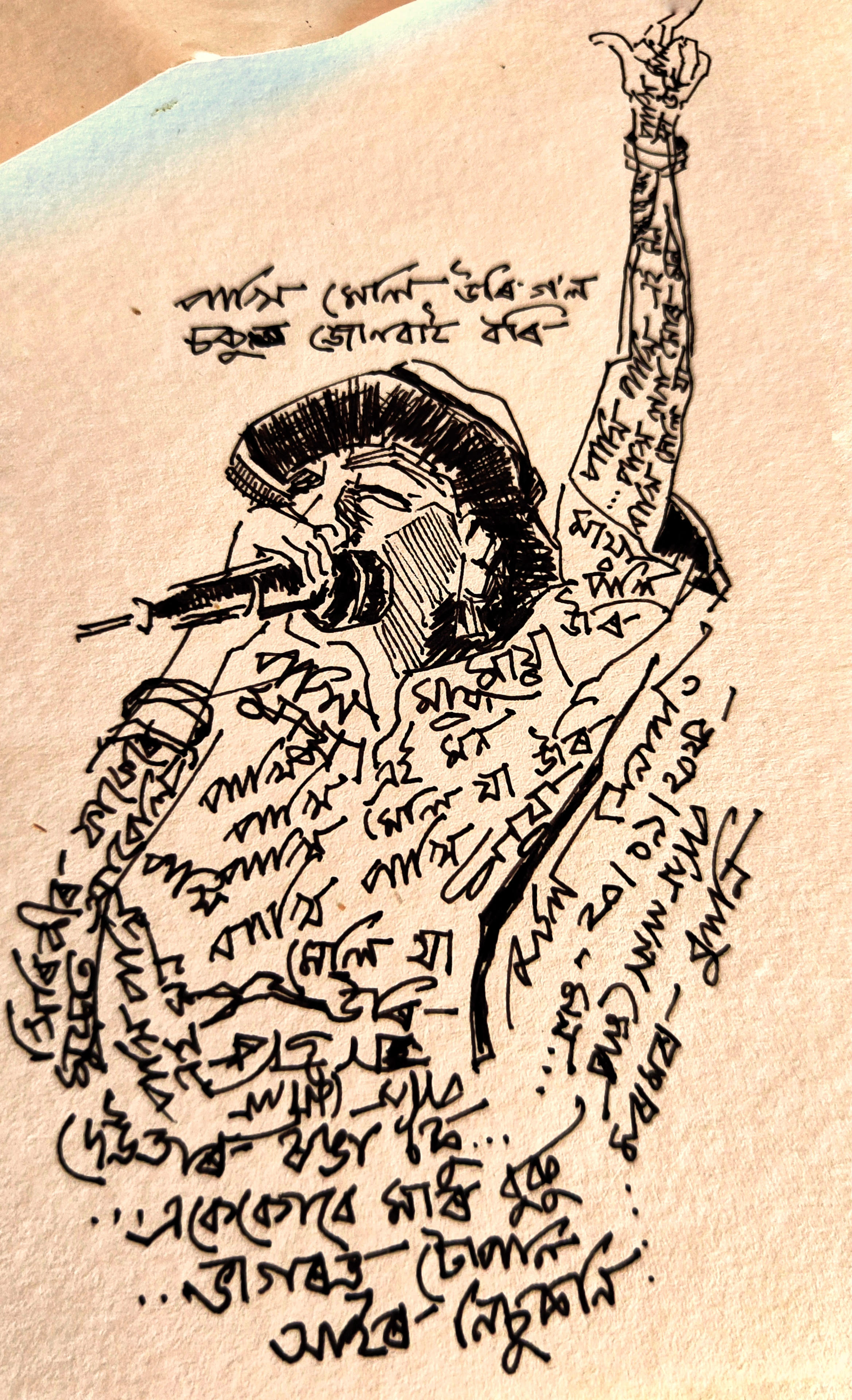
Similarly, in the corridors of Cotton College, the annual Freshers’ Socials were more than events, they were landmarks. One such evening, Arun Das took the stage, and the auditorium knew no silence that night. Me alongside a few other senior Cotton College Union Society (CCUS) members went to bring him from his one room den in Bijoya Hotel, near Apsara Cinema Hall in Paltan Bazar. It was a white ambassador car managed by our cultural secretary Deba Barman that made things work out smoothly for us. Clad in charisma, shirt out and flared trousers, bearded Arun Da’s very presence commanded stillness and storm at once backed with an artistic flavor. What struck me most was the humility with which it all began. Arun Da’s orchestra, his loyal band of musicians, took the stage first. They weren’t just warming up the crowd. They were setting the emotional landscape, painting it with notes of longing and nostalgia. And then… it happened. From behind the wings, without fanfare, a voice began to rise. “Monor Jatona, Tumi Nubuja”, fragile at first, then swelling with soul. The audience froze. Heads turned. It was Arun Da, singing from the wings right next to the few of us, his voice drifting through the auditorium like incense, gentle, haunting and simply irresistible. And then, with deliberate grace, he stepped into the light. He didn’t just walk onto the stage, he arrived. The cheers rose like a wave, unrestrained and thunderous, as if the very walls of KBR recognized his presence. From that moment on, there was no turning back.
He poured himself into every line, every lyric. When he reached “Tumi Janu, Jana Xun,” his voice trembled ever so slightly. You could see it, tears welling in his eyes, but never quite falling. That quiver in his voice was the song of every broken heart, every unresolved ache, every tender memory we’d tucked away. And in return, the audience gave him their silence, their laughter, their tears, and finally, their roaring applause.
Even the most reticent freshers, who moments ago were shrinking into their seats, were now leaning forward, caught in his spell. Final year veterans, too cool to clap moments ago, had tears in their eyes and pride in their smiles. Arun Da didn’t just sing. He reached across the divide of age, cynicism, and hesitation and brought us all into the same heartbeat. Moreover, from the wings, where a few of us huddled, hearts pounding, we knew something sacred was unfolding. That night wasn’t just about a song, or a singer. It was about all of us. Our time. Our sound. Our stage. And Arun Das was its soul. It was a reminder, a reminder that art could move us, unite us, change us. And long after the applause faded, the echo of his voice still lingered, etched into the heart of KBR, and deep into ours.
Romance in those days wasn’t loud. It tiptoed through glances exchanged across lecture halls, through shared benches and shared parathas at the Cotton College “Bondhu’s” canteen. A spritz of Brut Cologne announced a boy’s intent as clearly as a love letter slipped between pages of “Wuthering Heights.” And if you wore a pair of smuggled stretch Hara Jeans, tight at the hips, flaring just enough, you had everyone's attention. But what really sealed your legend was the pair of black Bruce Lee shoes with that unmistakable thin white rubber sole. They were silent enough for stealth and stylish enough to say you had arrived.
The romance wasn’t just human, it was spatial. Uzan Bazar, with its winding gullies and the scent of wet earth from the Brahmaputra banks, was a setting born of poetry. Many a young heart took the long walk from Cotton to Uzanbazar, pretending it was about a borrowed book or a promised notebook, when in truth it was about the hopeful miracle of bumping into her. Or him.
And when you heard the familiar thump of a Royal Enfield Bullet echoing through the lane, you knew Riku Da was around. He was our local cricketing icon, with his upper lip twitched sweet smile, who made the bat swing like a wand and the Bullet roar like a beast, was the poster boy for swagger. He had more fans than he could count, and probably more girlfriends than he could remember. He never said much, but he didn’t have to. The thump of his bike, that slow motion head turn, the tilt of his Ray Bans was enough.
Then there was Shyam (Raja), the quiet storm, the taekwondo champ who moved with a grace that most of us couldn’t even imagine. If he was not mounted on his Bullet , it was his green open Willy’s Jeep. Before we had even heard of K-pop or K-dramas, he brought to us the spirit of Korea through crisp movements, taut discipline, and an otherworldly calm art of Taekwondo. He would often practice at Kamrup Academy School or Nehru Stadium under the tutelage of Taekwondo Black Belt Fourth Dan Yumnam Khemchand and Titu Da, his white Seishin Dobok catching the first light, his spinning kicks silhouetted against the rising sun. People stopped in their tracks to watch not just the moves, but the way he seemed to speak to the air around him. Shyam wasn’t just a martial artist; he was a conduit between timeless traditions and the evolving eras.” I remember Khemchand, who was my doctor (Deboda Bhuyan- Bhai) elder brothers friend tell me one day, “We sportspersons are loved because of our integrity.” A graduate in Teaekwondo from Kikkiwon at Seoul in South Korea in the year 1991, it was Khemchand who founded the Assam Taekwondo Association in 1982 and later became a seasoned politician in Manipur. One quiet evening on our verandah, with mosquitoes humming their usual tune, I noticed Khemchand and Bhai da sitting unusually still. Suddenly, with laser focus, he snapped his thumb against his forefinger, and Lo and behold, there it was, a mosquito, lifeless in his palm. His reflexes were lightning. I just sat there, stunned. In that small, effortless gesture, he had my admiration. That early intrusion of Korean martial art into the heart of Northeast India was like a prophecy. Decades later, as BTS and Squid Game would captivate the world, we’d smile and say, we had our own K-wave long ago, in the form of a calm warrior named Shyam, Zufi, Gopal Thappa and others who kicked stars into daylight and left silence in their wake.
Evenings often ended with someone bringing out a portable cassette player to the hostel corridors or onto the Uzan Bazar steps. Someone would sneak in a bottle of Old Monk Rum or a Director’s Special Whiskey, and the voices of Jayanta Hazarika and Arun Da would rise again. Sometimes, love was declared in shadows. Sometimes, tears were shed with no questions asked. We didn’t have Google Maps, but we never felt lost. We didn’t have Instagram, but we remembered every face. We didn’t have camera filters, but the world, in its rawness, was beautiful.
Cotton College, with its colonial archways and eternal banyan trees, was our temple and Uzanbazar was its pulse. One held our ideas, the other our dreams.
We were dreamers with little money, a few books, and hearts that felt too much. We wore our stories like badges. The vinyls spun memories. The cassettes rewound our heartbreaks. The Bruce Lee shoes took us closer to our first dates. The Brut Cologne was our silent conversation starter. And Riku Da’s Bullet or Shyam’s quiet discipline reminded us that legend didn't have to roar, it could hum, it could kick, or it could simply be.
And though time has moved on, and Uzanbazar now has cafés where tea stalls once stood, and Cotton has Wi-Fi where once pigeons nested, something of us lingers in those walls. In that music. In that cologne. In the thump of an approaching Bullet. In the poetry of a look exchanged beneath a rain drenched awning.
And Uzanbazar was the stage where all this played out. Because if you lived it, you never really left it.
.jpg)



 (1).jpg)