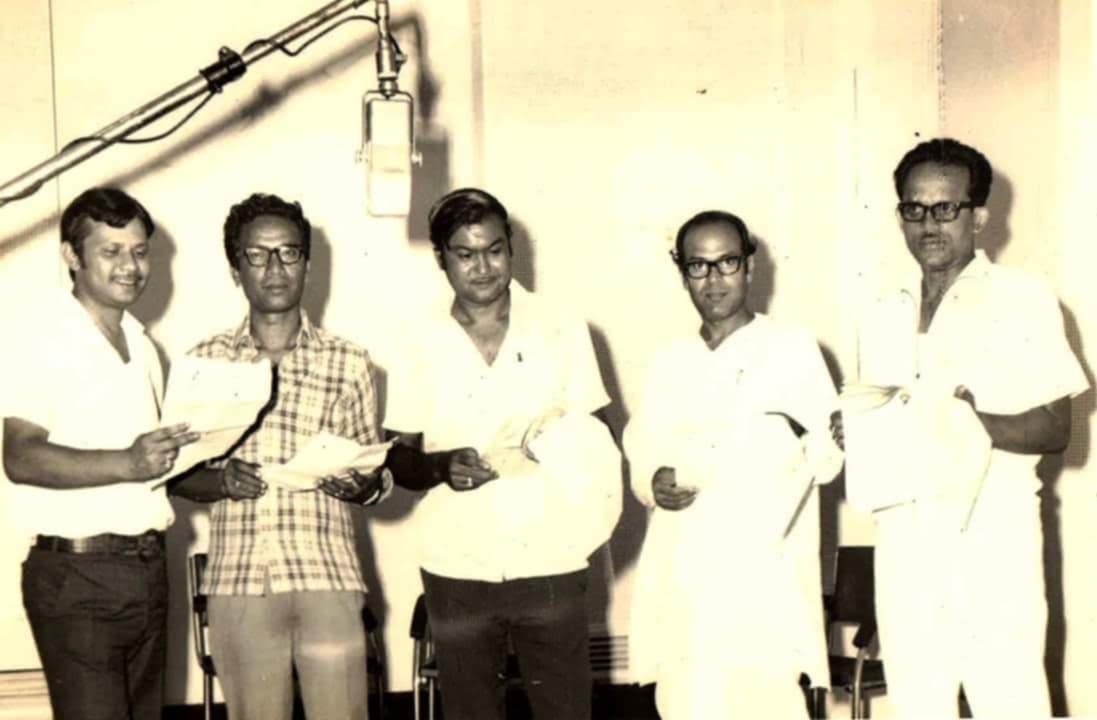
(Photograph from L to R : Dhiru Bhuyan, Makhan Dewan, Akhil Deka, Hem Bhattacharya and Arup Chakravorty at a recording session inside the All India Radio, Guwahati Station)
SATTYAKEE D'COM BHUYAN walks us through All India Radio, Guwahati which was once the cultural heartbeat of Assam
To speak of creativity in Assam without speaking of All India Radio, Guwahati, especially in the 1970s and ’80s, would be like narrating a song without its refrain. Perched regally on a lush hill in Chandmari, flanked by bamboo groves, swaying Krishnachuras and Radhasuras, and the lazy curve of a boulevard below, AIR wasn’t just a broadcasting station, it was a living museum of voice, music, theatre, poetry, and purpose. Moreover, there’s a certain romance in memory, especially when it's steeped in the scent of reel tapes, the warm glow of tungsten lights, the rhythm of a harmonium, and the hum of a violin being tuned in a soundproof studio. The vintage corridors of All India Radio, Guwahati, were more than just functional broadcasting zones; they were creative sanctuaries that cradled the soul of Assam’s performing arts.
I grew up amidst this wonder, guided by the graceful presence of my father, Dhiru Bhuyan, a broadcaster par excellence, actor, director, and theatre doyen. For me, AIR wasn’t merely a building; it was a living, breathing organism, pulsating with voices, ideas, and rhythms of a thriving artistic community.
The Boulevard to the Muse
Reaching All India Radio in Chandmari was a journey in itself. The winding road up the hill, still cloaked in dense groves and guarded by towering gulmohars, offered the promise of something magical. This was not just an address; it was a pilgrimage site for every creative mind in Assam. It had moved from its earlier location near the Bal Bhawan in Uzanbazar to this hilltop, bringing along with it the gravitas and charisma of Assam’s rich storytelling tradition. And there it stood, surrounded by the green cover, like a sentinel of voices.
Inside the Cathedral of Sound
AIR Guwahati was technologically ahead of its time. Walking into the air-conditioned studios, a rarity when barely any homes had such a luxury, was a revelation. The Studer reel-to-reel tape recorders, Telefunken microphones, Ampex multi-track machines, and RCA and Philips playback equipment, all kept in temperature-controlled rooms, were marvels of precision.
For a child growing up in this space, the first entry into Studio 2, with its heavy soundproof doors and glowing red “Recording” sign, was akin to walking into a sacred chamber. The technical and engineering unit was the mysterious cave of blinking meters and spools, manned by wizards who could bring voices back from magnetic tape.
Drama in the Air
The Drama Department was a world in itself. Names like, Satya Prasad Barua, Kulada Kumar Bhattacharya, Lakhyadhar Choudhury, Arun Sharma Phani Talukdar, Nilu Chakravarty, Tasadduk Yusuf, Dhiru Bhuyan, Syed Sadulla, Arup Chakravorty, Ishan Barua, Akhil Deka, Makhan Dewan, Mahendra Borthakur, Dr. Amarjyoti Choudhury, Dr Santwana Bordoloi, Bidyut Charkraborty, Bina Das Manna, Arati Das Boiragi and Niren Barua, echoed not just in credits but also in the very fabric of Assamese drama and AIR's legendary radio plays. The Sunday Afternoon Dramas were legendary. People across Assam would schedule their weekends around them. Radio plays like “Xurongor Xexot,” “Mrityunjoy,” “Baruar Sansar,” “Bai Saheba” and “Bhogjora” brought entire neighbourhoods to a standstill.
“Voice was our scenery,” Arun Sharma once told my father, sipping tea in the canteen. “We had to paint it all with silence, sighs, footsteps, and breath.” My father, Dhiru Bhuyan, along with Phani Talukdar, Satya Prasad Barua, Niren Barua, and Nilu Chakrabarty, created theatrical magic using just the voice. The rehearsal rooms often echoed with arguments about intonation, pauses, and the placement of a breath.
Rehearsals were intense and immersive. I remember watching my father, Dhiru Bhuyan, mark his script in pencil, his voice perfectly modulated even during run-throughs. The drama studio smelled of ink, old wood, and anticipation. Lines were rehearsed with the same gravitas as a stage production. Dubbing was done with single takes, and errors meant rewinding large reels and starting again. Precision was the religion.
I remember once hiding behind a studio curtain as my father recorded a monologue. I was too young to understand the meaning, but the gravity in his voice shook me. That was my first realisation of voice as power. Another memorable program was “Nukuwai Bhaal,” a gentle, rustic slice-of-life show that reached every tea estate and village hut, celebrating dialects and folklore scripted by Mahendra Borthakur and performed on air by Durgeshwar Borthakur and Meera Das at 8:00 pm. Similarly, “Akonir Mel” steered by Anu Roy Choudhury and Senehi Begum was another hallmark towards the youth segment.
Melody, Memory, and Mandolins
The Music Department was a mosaic of melodies. Dr. Bhupen Hazarika often dropped by, his booming nasal voice, unmatched charisma, and words like fire. His younger brother, Jayanta Hazarika, brought a more contemporary, experimental air with him. Artists like Pratima Pandey, Hemen Hazarika, Purushottam Das (instrumental in classification of our songs) and Khagen Mahanta formed the backbone of the Assamese musical identity. Watching Johnny Joseph and Dilip Rasaily on violins and Subba jamming on guitars was an experience that words fall short to describe. Bulu Bordoloi, with his accordion and piano, could create storms and stillness. Prabhat Sharma’s flute often made one pause mid-step outside Studio 4, the notes floating like petals. Gopal Boro, the master of the mandolin, made strings sing like birds. These musicians didn’t just perform, they conversed in tones, laughed in rhythms, and cried in scales.
The Canteen Chronicles
Ah, the AIR canteen! If the studios were sacred, the canteen was bohemian. Tea in white cups, singora, gojja, kochori, and long addas. It was here that Kirtti Kamal Bhuyan, Labu Senapati, J.P. Das, and others argued over lyrics, scribbled last lines, or debated global politics. On special days announced Hiru Da landed up to add to the glory. It was more than a canteen. It was Assam's unofficial coffeehouse of ideas, minus the coffee, but filled with passion. I remember once overhearing a conversation between my father and lyricist Kirtti Da, discussing whether a particular Assamese word carried more 'melancholy' than another. That was the depth of craft.
Youth, Hartals, and the Airwaves
During the Assam Agitation, AIR became a frontline witness to history. Hartals, strikes, and picketing were the norm outside, but inside the hilltop station, there was a quiet determination to keep voices alive. Announcements often had to be rewritten, sometimes live, to reflect the tension in the streets. A few times, AIR itself became the subject of contention, should it report, resist, or retreat? I remember being inside the station on one such day when stones were being hurled down the hill. We weren’t scared. We were alive.
Announcers, Mentors, and Microphones
The generation that shaped the next included Aboni Bora, Nayan Prasad, Mridul Hazarika, Padma Gogoi and others, who were junior announcers and programme officers then but mentors in spirit. I later joined the Western Music section, airing at the iconic 2:10 p.m. slot, alongside my senior Aloy Das. It was kickstarted by seniors like Keteki Bardoloi and Rita Barabara. That show was our secret rebellion, a curated hour of Beatles, Bee Gees, and Bread, giving Assam a window to the world beyond.
The station also featured riveting panel discussions, poetry hours, and children’s storytelling corners, Akonir Mel to ttake stronghold on Sundays. It was as if all of Assam’s consciousness was compressed into that one hilltop complex.
The Way Back Home
Once recordings wrapped up, the journey back home, rickshaw rides down the hill to Uzanbazar, was equally magical. We’d often stop at tea stalls near the Assam Tribune building, then the tallest structure in that part of Guwahati. My father would chat with poet Hiren Bhattacharyya or writer Nirod Choudhury, their conversations laced with verse and philosophy. The air always smelt like ink, rain, and radio waves.
Eternal Frequencies
Many of those voices have faded, Ashim Hazarika, the soulful young singer, among others. But their echoes remain, caught somewhere in a spool, a memory, or a heartbeat. AIR Guwahati of the ’70s and ’80s wasn’t just a government station. It was a university of expression, a shrine for sound, a melting pot of Assam’s finest minds and hearts.
And for a child growing up under the glow of a father’s legacy and the warmth of those vintage microphones, it was home. Even today, when I pass Chandmari and catch a glimpse of that green hill, I do not see buildings. I hear voices, rich, vibrant, unforgotten. The hill speaks. And I still listen.


.jpg)







 (1).jpg)


