BY ABHIJIT RABHA
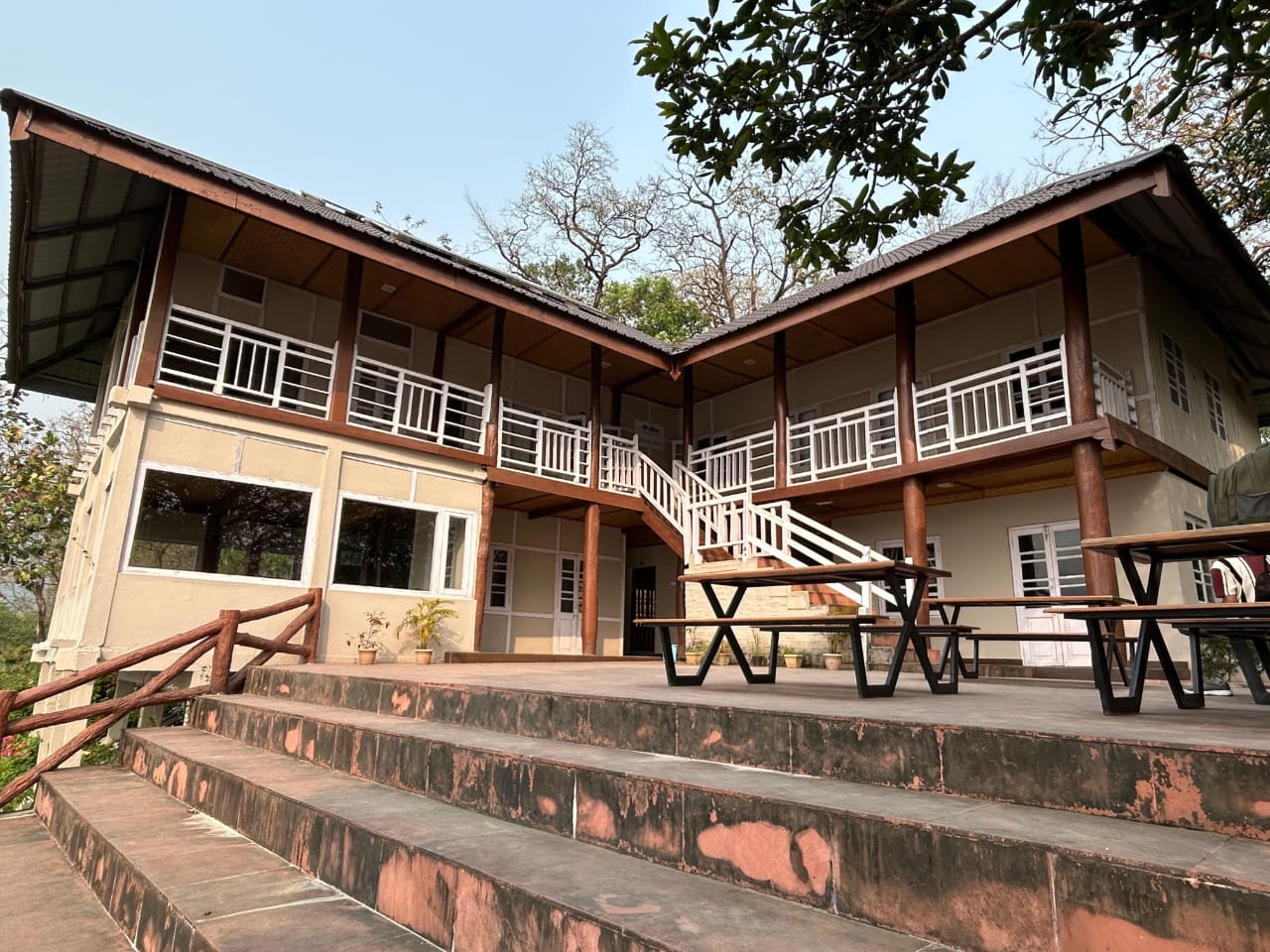
Despite the vagaries of time, they all stood with glory, with loads of history to tell. I am now reminiscing about the proud timber structures that once stood against the vagaries of time and elements of weather. They stood on timber posts as stilts and were of two-storied configuration, the lower one serving as a resting place in those hot and humid days. The walls were framed with sawn wood and came up with Lime-Surkhi mix pasted over the sturdy Ekra reeds. The structure housed enough foresters to keep strict eyes over the wildlife law infringements. The water supply came from the nearby rivulet or from a solitary hand-pump made in some hoary past. The roofing was mostly of thatch, later replaced by corrugated iron sheets.
If in those times, one visited the headquarters of the Monas Tiger Reserve, you would find it by the ox-bow lake called the Mora Manas. Prior to the quake of 1897, the channel of river Monas flowed by this route, emerging behind the old Inspection Bungalow (IB) at the township of Howly and debouch at the serpentine rivulet named the Palla. The convoluted passage of the Palla vied with the complex pattern of Jalebi made by the sweet-makers at Barpeta some eleven kilometers away from Howly. Again, the Inspection Bungalow of the Project Tiger complex, originally belonging to the North Kamrup Division (1956-1970) was a piece of wonder. The IB was not constructed in-situ. It was dismantled at faraway Bijni and reassembled at Barpeta Road. Therefore, the timber posts turned little less in length and the roof was lower. But nobody seemed to talk about it.
With the recent expansion of the Monas National Park, the Kuklung Range was included inside the same. The Kuklung Range Inspection Bungalow had a two-storeyed and very old history. Many Mahaldars of Elephant Capture Mahals in the Monas RF used to talk about this beautiful timber structure. The range complex along with the IB stood on the edge of the old Monas road, grazing the south boundary of the Monas Reserve Forest. Further to the east, there was a similar double storeyed and stilted IB/range office of Panbari. It stood on the west bank of the river ‘Burisuta’. This river is known as the Sukhanjan, a transboundary river, marking the west boundary of the erstwhile Monas Game Santuary notified on 1st October, 1928. Later, this Game Sanctuary and the North Kamrup Game Sanctuary were amalgamated to form the Monas Wildlife Sanctuary ( 391 sq kms, circa, 1955). Again, the beautiful structure did not last past the early parts of the year 1989. It was razed to ground by torching it by miscreants during the hottest part of the Bodoland Movement. On the same bank, the forest Beat of Gobar Kunda had a similar structure which served as an inspection bungalow, ditto, Lafasari.
On the other bank, i.e. the east bank of the triune flow of the Monas, Beki and Hakuwa, stood similar grand structures at Narayanguri/Naranguri. The original inspection bungalow at Matharguri was by the bank of the Beki channel, facing south during the colonial period. It was washed away by floods. The grand looking Matharguri Forest IB served the dual purpose of sheltering the visiting various forest officers, dignitaries and all kinds of inland and overseas tourists. In the ‘50’s, 60’s, 70’s, the IB was used for overnight camping for the eager beaver anglers from world around.
The construction of the Matharguri IB commenced around 1955-56 on the top of a hillock. The steep approach road was constructed by using bamboo wall to support the filling up of the cut portion of the hillside. Initially, it was only a single-storied building. The posts of the building came from Kuhirghat area of Panbari RF. The Kuhir timber, from Bridelia retusa; is known for its hardness. However, the harvested timber was so tough that the wood workers found their hammers bouncing off the nails which would not go into the Kuhir posts. Then the lower bungalow came up sometime in 1958, with the help of a contractor from Barpeta town, the subdivisional headquarter of Barpeta Subdivision of the undivided Kamrup District.
However, much was to be done for the water supply for the running water system. No water pump, however powerful, could lift the water to the height where Matharguri IB ( Ek number Bungalow) stood. Late P.N. Lahan solved the problem by upturning the delivery end of the water pipes issuing from the pump. Then the pumped water flowed up and filled up the tank with gushes of intermittent flows. The water was nearly uncontaminated and none complained about any upset stomach. Instead, everyone felt refreshed and hungrier even. However, the IB was in the depth of the core zone and eventually was closed down for visitors a few years ago. End of history for this beautiful building.
Down south of Matharguri, Rusingla , Uchilla (Oosla in the account of the Maharajah of Cooch Behar, MCB) and Burhaburi had such grand timber and reed walled structures. To the east, the Koklabari forest camp stood by on a raised ground by the stream named the Randhani Bandhani. The IB at Bhuyanpara , razed down in 1990, was similar in looks and structure.
The water supplies were essential in such encampments. The well at Kuklung Inspection Bungalow was deeper than 200’. And access to this life giving and life sustaining liquid was limited in the drier season between January and March. The Rusingla and Oosla drew their potable and utility water from the streams of similar names respectively. For drinking, in the rainy times, one filtered them through fine cotton mesh of several layers of Assamese towel called Gamocha followed by thorough boiling.
However, with the advent of gravity fed water filter with micro filter candles, made the job less painstaking. The act of cooking could not be done as it is not done on the timber floored building, Therefore, the cooking shed was single storeyed affair, on a nearby plot. The wild elephants, quite ample in number even in these days, used to trouble the kitchen house for a lump of precious salt.
But, Matharguri ( Mathangurie, Mattalgoorie in colonial lit) has a chequered time-line altogether. It was an accounts forest Beat Office by the same name. It was formerly occupied by a small settlement, ejected in the year 1914 along with that of Ruisingla area. The clumps of home-grown bamboos remained over time to prove that. Once, the river channel named Beki, emboldened by a stronger flow of the river named Dang (Drang?) Me Chu of Bhutan with its origin stated to be a point below the pass named the Bum-La in Arunachal Pradesh did something wonderful. As the waters eroded a part of its escarpment, the ever curious, ever vigilant staff of Monas Wildlife Sanctuary found a silken bag jutting out on the cut. It was a bag of Muslin cloth, with silver coins stashed therein The coils had Persian script with the name of Almighty Allah inscribed there. Nobody had any idea how the bag got there. The bag along with the coins were faithfully handed over to the Department of Archaeology, Assam. The man/officer responsible was on Phookan, a Senior Wildlife Warden of Assam Forest Department.
The Beat Office of Matharguri had quite a sprawl, with the facility for encampment for Mahouts, Boatmen and other forest personnel like Foresters, Forest Guards and Game Watchers. The old temple of Goddess Kaali was as old as the time itself and regularly the yearly worshipping followed with dignity and fervour. It was believed that the Goddess was a protecting deity in those ancient jungles.
(note: Similarly, in the distant Kaziranga National Park, the belief in Kakomai, the Goddess Durga/Kaali is quite widespread. The alternative history states that , the Ahom King, Gadadhar Singha, when as an escapee from the tyrannical rule of ‘Chulikpha’, reached the spot called Dusuit/Dui Suti and dozed off under an elephant apple tree. The breeze got strong enough and dislodged the heavy fruits that descended painfully on the sleeping king to be. Around his neck was a bamboo cylinder housing a stone idol of Goddess Kaali. Not being seen protected from such physically painful condition, he, out of anger, threw the bamboo ‘choonga’ to the waters of Duisuit. The fishermen folk, guided divinely and unerringly, recovered the deity and it eventually found its final place at the Kakomai Than near Kohora. )
From the older generation Mahouts who had earlier seen actions in the elephant capture Mahals, I came across a paranormal story that took place long ago in the Mathargurie Beat Complex.
Once, out on a long range patrol, a group of jungle patrol reached Mathargurie and camped around a raging fire. The fire kept out the pestilence of wild animals, mosquitoes and ofcourse the ghouls too. In the middle of the night, a dis-embodied voice started addressing them. And a clanking metallic pot started rattling around. “I am thirsty and hungry like hell! The one who would sacrifice a black coloured cow tomorrow for me, would receive the potful of gold coins.” But none dared to wake up nor carry out the sacrilege of sacrificing a cow.
Bang down south of Mathargurie, lay the olden Kahitama Beat with a specially built stilted and thatch roofed house. The house is no more. But it housed late Chakrapani Ayyengar Rama Bhadran, IFS of Assam cadre in 1935 who was in charge of the sanctuaries to quell the rhino slaughter sweeping over the NK and Monas game sanctuaries.
Towards extreme east, next to the stilted Beat / Camp of Koklabari, lay extreme amounts of cow dung collected from the nearby Bathaans or Khatals. While making a mistake in land nav my official 4X4 got stuck to its hood in that smelly stuff. It had to be extricated by a tractor pull.
Buffaloes were menace to the grassland ecology. Their enormous weight, transferred through their eight hooves of each animal, compacted the soft topsoil of the grasslands in no time. The import of the nitrogenous fertilizers (Read, dung and urine) made the compacted soils an inviting ground for the woody species and an invasion was experienced.
Incensed, I fumed. And got down to a business special. At Oosla beat, I met the leader of the conservation team of the MMES ( Monas Maozigendri Ecotourism Society). And I suggested that it was no harm to ‘harvest’ the domestic cattle for protein in such arduous field conditions. They needed to shoot and kill the grazing buffaloes one by one and dry meat ration be prepared for a long comfortable duty. I won. It happened and I secured area dominance under harshest of the conditions. Far to the west, a powerful politician fumed and nearly caused a conflict of interest !
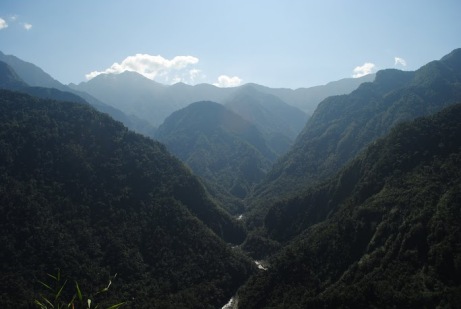
Gone are those days of an wide open sky, the pelting rains dancing on my head. Gone are the days of those timber structures which blended so well with the visual quality of Monas of those times. I can only recall and write a few lines. Particularly I regret the conversion of the Mathargurie Number Eik Bungalow to a namesake forest museum. It has no historical content whatsoever. So many tete a tete, so many wonderful conspiracies, so many whispers of the gorge wind…. All faint memories now.


.jpg)








 (1).jpg)


