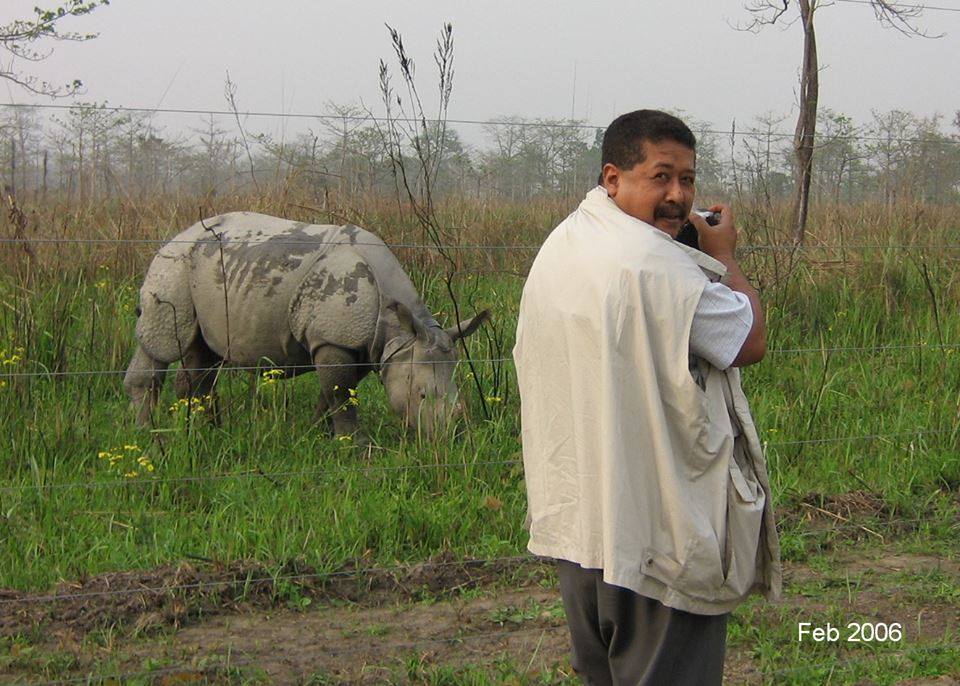
The colonial foresters had an effective repellent to ward off ticks. They added Naphthalene powder, Turpentine oil, plus a few drops of Carbolic acid to the scalding hot bath water writes ABHIJIT RABHA
Persons familiar with the wilderness landscapes of some other areas are confounded when they come in intimate contact with the landscape of the Dooars area wilderness. Here, we are discussing about the Monas National Park as I found it in the early 1990’s.
The river Monas and its three channels (‘Lejera’. Coll.) were the only perennial sources of flowing water. The channels developed within the political boundary of India, west of Matharguri (Mattalgoorie, colonial expression). After the river Dang Me Chu reaches the confluence of Mang De Chu at the point named Dui Mukh, the river takes on the name of Monas, Manah or Manas. After the great flood of the year 2004, Hakua and Monas dried up and only one channel, the Beki flowed with vigour. The flow in the river Monas during the flood of 2004 was estimated as 10,500 cumec.
The rivulet Sukhanjan had earlier marked the western boundary of the Monas National Park when it was notified as Manas National Park in September, 1990. Downstream, the rivulet emerges in a perennial form with a new name ‘Burisuta’.
On the 1st October, 1928, the tract between Sukhanjan and the middle of the river Monas was declared as a Game Sanctuary. It was actually a part of the Monas Reserve Forest. Hence, the area was called Monas Game Sanctuary. On the eastern bank of the rive Monas, the North Kamrup Game Sanctuary too, was notified on the same day. Monas Wildlife Sanctuary (1955) was an aggregation of these two above. From the status of North Kamrup RF (1907) and Monas RF (1914), this has been a long journey. Now, the tract of earlier Monas Game Reserve along with a part of the Monas RF upto Kanamakra river forms the western part of the National Park in these times. However, the fact that this area was already elevated to a game sanctuary in 1956 by Government of Assam. hunting and sports fishing was to be under licence issued by the Conservator of Forests, WAC. Only reputed and experienced hunters and shooters were allowed.
This tract is very dry with scarce sources of water. The Sukhanjan Beat in Indo-Bhutan International boundary accessed water by digging into the sand of the river bed. The river Gobar Kunda, has a presence of high escarpments and boulder strewn dry bed. Somewhere west of Sikhlaijhar beat of the Panbari Range, lies a muddy depression called the Badari beel. By default, the dry area promotes a pinch period for life sustaining resource called water. All the wildlife forms congregate here to slake their thirst. The water is murky and stagnant. During the exercise for estimation of wild free ranging elephants in the Blocks IX (a,b); a two-member team on elephant back arrived at this location at the end of the day. They had only Badari Beel’s stagnant water as a source of water, which smelled of putrid decaying flesh. The elephant went thirsty as it refused to be near the water body. The other two, Purna Rabha and Kandarpa Das, both of them mahouts had some different idea. Refusing to give up, they used four layers of their gamocha (Assamese towel) to filter out the particles and boiled the filtered water. However, the putrid smell did not go away. In the first light of the next morning, a small recce showed what caused it. A putrefied body of a tusker elephant was lying at the other end of the water body. The carcass was left there after the poachers killed the elephant and sawed off the ivory.
The pertinent question arises: what is the water regime and the drainage? And why is it so peculiar?
The underlying cause is the geology of the Dooars landscape which runs along the foothills of the Sivalik Mountains of Bhutan. The south bound drainages include a lot of dry, boulder strewn rivers in the Bhabar Zone. It is characterized by very deep-water table. The water percolates down to encounter an impermeable canker pan. This results in a sub-surface flow to the terai region to the south. The flow of the streams to the north emerged as underground spring. The same contributes to the perennial rivulets like the Kasimdoha, Palsiguri and Bhatgelli. The easternmost Bhumuk or Bhumka, a local parlance for the underground fresh-water spring lies at the Koklabari Reserve Forest. Surprisingly, the ‘Bhumuk’s are absent west of the Bansbari Matharguri road running twenty kilometres south north. Neither we are aware of any of such in the Panbari Range area.
The rivers or drainages carry different names in different zones or localities. The Semajhora/Shyamajhora becomes Angulichinga, then flowing down south gets the name Pahu mara or Pomara. The Dwimary, as known in the Bhabar Zone, becomes Makhibaha in the intermediate zone only to be named Rupahi while exiting the southern boundary of the Park. The names of the drainages are compiled and presented as an annexure. This was done at the time of writing the first management plan of the MNP (2001) when I worked there as a Conservator of Forests and the Field Director of Monas Tiger Reserve.
The Monas Landscape and its wilderness attributes were different from other wilderness landscape in an obvious sense. The sloping Bhabar terai formation afforded tall grassy plains. In the height of the summer, certain species of grass grew as tall as to hide the elephant borne personnel as they cut through the vastness of the grasslands. It is where one can ‘savour’ the real pestilence of the blood sucking insects and other parasites. Gnats also known to Assamese as Danh (দাঁহ) attack the elephants and elephant back personnel in swarms. It is the time for the Mahout to cut off a small leafy twig from the overhanging branch of a tree. It is used as a make shift fly-swatter of sorts. The elephant is not spared by the Danhs. So, the Mahout keep swatting the large fly like Danhs off the elephant’s head and fore parts. The mosquitoes are of many types, not just the typical Anopheles and Culex spp alone. Lucky are the forest personnel who never suffered the bouts of malignant malaria. We lost quite a few frontline personnel due to the malignant malarial fever. The year 1994’s summer was a special dateline with this kind of fever caused by P. falciparum, a blood parasite and known to be a Zoonotic disease. It is of great interest to know that the massive wave of this malarial disease swept through the north bank areas of the Brahmaputra and this synched with the massive destruction of the natural growth forests in the same landscape: Charduar, Naduar, and the forested areas to the west.
The leeches of various types would cause another type of distress. The nearly anaesthetized bites of some larger water dwelling leech species can be of great damage to the leg muscles. The water bodies of Kaziranga and elsewhere harboured what is called the ‘Buffalo Leech’. Once it sticks to somebody’s thigh or lower legs, it grows in length as rapidly blood is sucked by it. After a small passage of little time, it can encircle the entire thigh or the calf. But such experiences are painful as the bite results from a large bleeding gash and heals slowly. The striped leeches are everywhere. Known as the ‘China Leech’, they lie in wait everywhere; from the blades of grasses, leaves, foliage, even the branches overhead. The first ones to cross such areas are lucky. The leeches sense the passage but silently drops on the following second or the third and the whoever follows onwards. Sometimes, when the elephants are forced march over stagnant pools, the monster leeches called the ‘Elephant Leech’ attack the navel of our departmental elephants and attach themselves till they drop off after engorging themselves.
All of them, if they get you in large numbers and one did not attend to their continual addition when are marching through the floor of the grasslands, the experience is a horrible one. While working as an Assistant Conservator of Forests in the undivided Nowgong forest division, in the month of September of 1986, I had a harrowing experience. The place of operation was the Kukrakta Reserve Forest and we were in a hot pursuit of some rhino poachers up there in the hilly terrain of the said reserve, close to Kaziranga National Park (notified in 1974). At the end of the chase operation, I found that more than fifty leeches were hanging from both the legs from down up. Thank God, they missed the crotch region. There is no medication except for traditional ones. The ash of burnt cotton clothes absorbs the blood and the coagulant released by the leeches and there you are. But do not forget to mix few drops of mustard oil in the ash.
The ticks are the round the year activists of blood sucking parasite world. There are some well-known varieties: Deer Tick, Tiger Ticks, Elephant ticks and so on. Nothing compares with the after effects of the Tiger Ticks for sure. The bite instills sudden violent vomiting, fever and sometimes uncontrolled tremor and so on. The pohu chikora or the deer ticks like to dig into the soft parts behind or under the years, the thigh joints and so on. The mouth parts are so deep into the soft flesh that the pain brings in discomfort and sometimes feverish conditions. They have to be pulled out by using a heated pin to dislodge the parasite.
The colonial foresters had a nice repellent by adding the following to the scalding hot bath water: Naphthalene powder, Turpentine oil, plus a few drops of Carbolic acid. This concoction travelled to our generation of forest officers till mid 1980’s. I found this very useful after finding in a book named ‘The Forester’s Companion’ by M.H. Mascarenhas. Carbolic Acid Soap used to be available in those days in the of 5-10% strength. The same is a Phenol and it can penetrate into organic matter. It worked well with ring-worm infection of the skin. Once out for a cross-country elephant ride in Monas National Park, I developed the exact symptoms of the bites of Tiger tick. But, fortunately recovered. The tick must have dropped off early enough. This was back in the early 1990’s when the estimated tiger individuals numbered a phenomenal 93 numbers. This was the reality of those days.
Forest Officers, a few of them, knew about the warming of the weather up in the mountains long ago. They had no access to weather data. But, by studying the anomaly of the gorge wind of the Monas, one of them could come to this conclusion. A strong gusty wind blows there at Matharguri hill top, also at the salient of Gobar Kunda where, earlier forest inspection bungalow constructed on timber stilts and wooden planks existed till 1`989. It subsequently got razed to the ground after miscreants torched it. Sonadhar Doley, IFS, then a Divisional Forest Officer of the Western Assam Wildlife Division based in Barpeta Road in the 1970s installed a water pipeline from a source inside Bhutan to sustain the staff posted in Gobar-Kunda Beat. The name got twisted, in downright wrong way to Gabhorukhunda.
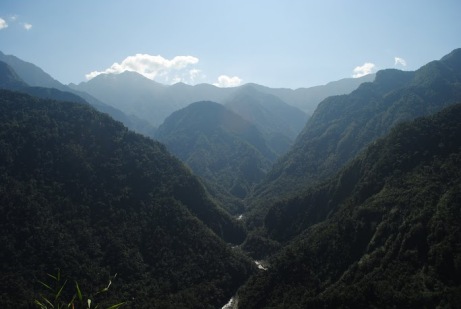
The gorge of Dang Me Chu in Bhutan heats up and rises up during the daytime. As the cold air of night descends there, forces the heated air out through the gorge out in the plains of Assam. The exact time of the arrival of this wind and weakening of the same was always the same. One of the field directors noticed the odd variation of such timings in the 1990’s as compared to 1970’s. He concluded that the upper reaches must have heated up. Yes, the river’s source is near Bum-La in Arunachal Pradesh. The river course served and still serving as a natural feature allowing the aerial navigation to Tawang from Guwahati. One of the tributaries of Dang Me Chu flows from some un-named glaciers of the northern Bhutan Himalayas. By 2025, a report said that over 20 glaciers are gone from Arunachal Pradesh-China boundary.
For the earlier generation of field staff of Monas, then a wildlife sanctuary who saw their service in the period of 1950’s to 1980’s had a lot to tell. The name Kuri-Beel evoked emotional response. It was a shallow stretch of wetland located east of Panjhar area. It had a population of what the local denizens called as ‘Gal-Dighla’. In fact, these were one of the most beautiful Swamp Deer peculiar to Monas. Their innocence nearly caused a serious decline. But our team consisting of Sukumar Momin and I, suddenly spotted a group of four of them. Initially we were confused. They resembled a well-fed kind of long necked deer. The locality was Ruisingla on the Usla-Ruisingla road leading to BM road forming a trijunction. The spot had an opening and there they stood, ignoring us almost amidst a growth of Aesculus assamica (Raman-bih, a fish poison).
If this species proved its survival due to kind of an incredible resilience, I thought, more similar surprise was in store for me. After the great flood of 2004, I was able to lead a cross-country long range patrol with our staff from Matharguri, via Garuchara , Dwimary , ending at the bank of Kalanadi. Enroute, we found a lone sub adult rhino alive and well. What I did not know was an important historical matter. An Indian Forest Service officer who joined the Assam Cadre in 1928 was sent to Monas in 1935 by Arthur Jones Warren Milroy, the Conservator of Forest, Assam. His name was Chakrapani Ayengar Rama Bhadran. He would later rise upto the position of a Conservator of forests and retire from the earlier state of Madras as the Chief Conservator of Forests. Having controlled the rhino slaughter with the capable hands of Ranger Bhakhru Ram Kachary, a forest ranger; he was succeeded by Justmon Swer. The former was an Assistant Conservator of Forests and the latter, an Extra Assistant Conservator of Forests. It is mentioned in colonial reports that C A R Bhadran mentioned about the rhinos migrating up the Bhutan hills during a particular season of the year.
This hint of transboundary movement of wild biota is well known with the Indian Bison (Bos gaurus). The herds of the Bisons would descend by the early part of January on both the sides of the river Monas. For thousands of years, the river Monas had been a geographical barrier for the Golden Langurs from dispersing to the other side. Tigers, Indian bisons, elephants and deer species; all are dependent on the salt licks on the southern aspect of the Bhutan hills. My observations showed that the tigers hunted more of Bisons during this seasonal visit, as a favourite member of the prey base of the mega-carnivore.
There were large scale mortalities of the Hog Deer in the transitional period into Y2K. Hundreds of carcasses had to be buried as nobody knew or had any clue what was causing such a mass death. It was quickly followed by similar but little less intensity with the Sambar Deer. This was a big departure from the early nineties decade. Then they were in large herds and behaved quite like robust horses in their gait and build. Even, those large herds of Hog deer disappeared by Y2K. Persecution by poachers is a different aspect. However, the Pygmy Hog, Hispid hare and Bengal florican still held on. The conservation-oriented villagers of Rangapani village near the eastern boundary of the Park achieved a remarkable feat. After recovering an egg of a Bengal florican, they got it successfully hatched by a female duck. And the first ever such attempt bore fruit; the villagers called it ‘Khungri’ and became the mascot of the Monas Maozigendri Ecotourism Society. I was its founder along with a few local student leaders.
Conservation efforts in the community way to recover Monas was the only way to do it. The inherent pride of the indigenous people surrounding it centered around the beautiful landscape.
For the reasons of so many kinds, including strategy, emotion and struggle over decades, recovery of Monas became a Vox Populi. After all, there is a need for a new world for the next generations to come. The elements of initiative, innovation and improvisation helped our team to achieve in. what was the Mission Impossible. The team faced its trials, tribulations and back breaking efforts. There were the usual lot of back-biters, berating talkers, conspirators and the lot. We never gave up. The Maozigendri Model was effective and we call it India’s best. We had the unusual help from certain groups from beyond the landscape.
Some other non-governmental organizations pitched in their help, whatever was possible.
Here, we collectively, but always remembering the community led by the MMES, say we were the guys without choice!


.jpg)








 (1).jpg)


